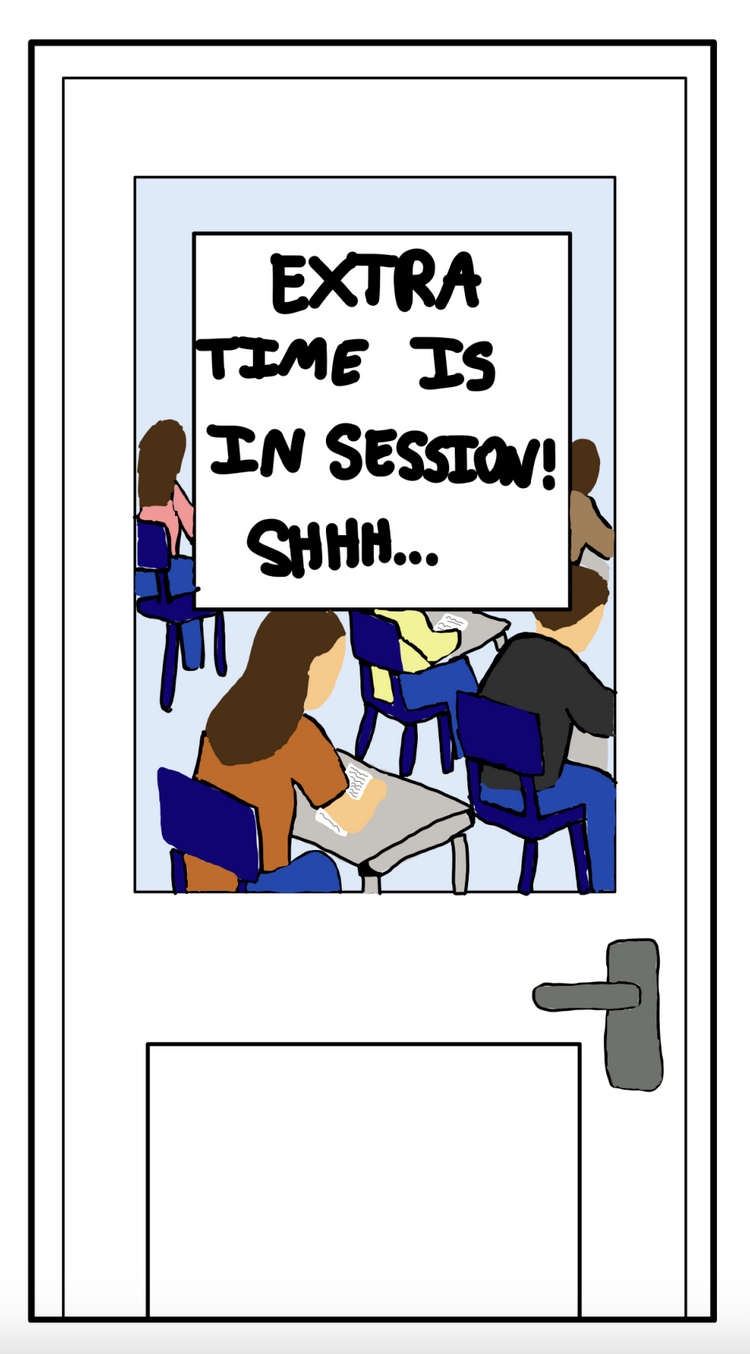
An increased number of Heschel students have been prescribed testing accommodations, such as extended time, over the past few years. Students insist that teachers have gradually lengthened their tests to fit the extended timing schedule, thereby putting students with regular time at a disadvantage. Despite concerns regarding the excessive availability of extra-time accommodations, Heschel’s policy remains largely unchanged.
Yes, many students have learning disabilities entitling them to extra-time. It appears, however, that many students who receive extra-time do not need it, and many who do need it cannot afford a diagnosis. With enough money and the right doctor, parents can almost guarantee accommodations for their kids; the well-intentioned system is easily exploitable.
Heschel has made some progress. In the past, students with extra time had breaks between their work periods; for example, a student could begin their test during Period 1 and resume it during Period 5, leaving sufficient time between testing periods to violate academic integrity: this system raised cheating concerns.
Assistant Head of the High School, Anne Cohen, rearranged the schedule to ensure that extra time sessions occur back to back – either during lunch or after school. This change exposed the rampant abuse of extra time. Teachers have found that many students only use their extra time when it fits their schedule, showing up for lunch extra time, but not after school.
Legally, all students must receive their diagnosed testing time, some requiring either 1.5x (time-and-a-half) or 2x (double time). Heschel can’t, and shouldn’t, change whether students receive a diagnosis. But it can alter the testing policy to even the playing field.
The Ramaz School, for instance, updated its testing policy a few years ago: all students receive 1.5x time. The students who need 1.5x time still receive it, but to combat exploitation, regular time students receive it as well.
In an interview, a Ramaz student claimed that this was an endeavor to bypass extra time altogether. Although teachers claim their tests are meant for a 30 minute period, they are really fit for a 45 minute exam. But this system is also problematic, as it undermines the rights of students requiring accommodations.
Another potential solution would be to eliminate timing on tests altogether. If tests were untimed, all students could take whatever time they needed and thus have a fair playing field. For this to work, however, tests would need to be shortened to fit our packed schedule.
Others have argued for the simplification of tests. Tests should not be testing your ability to complete complex problems in a short time, but instead whether you understand concepts. On math tests, for example, problems should be simple. Either you know how to do it, or you don’t: no long simplification and complicated numbers that challenge your speed and not whether you understand the material.
Heschel’s World Language department often follows this approach. French teacher and World Languages Department Chair Céline Clerfeuille is known among her students to give fair tests for which extra time is included in the class period. Even students with double time tend not to spend outside-of-class time on her exams.
Clerfeuille said, “I test students in order to make sure that they know the material and are able to showcase that knowledge with as little stress as possible.” She continued, “I intend for my tests to take no longer than 25-30 minutes for students with no extra time… Again, I don’t want stress to be a factor in the student’s process- I just need to see whether they know and understand the material. Added stress skews the process in my opinion… I’ve found that just telling students that it’s a 30-minute test reduces stress and therefore reduces the use of extra time for most students.”
Clerfeuille concluded, “This has been the best approach for French. I get to assess students’ progress within my class period, with relatively low stress (for me and for students!). I still get to test students on a variety of topics, I just give them fewer questions. This doesn’t mean that the test is easier- it’s actually not since you have fewer questions to demonstrate your knowledge of the material. I’m obviously not an expert in other subjects, but I think [this method is] worth exploring.”
It is clear a change is necessary. Extra time is broken, and the administration must fix it. Shorter tests are one of the many potential solutions.
This story was published in Heschel Helios on Dec. 7, 2025.