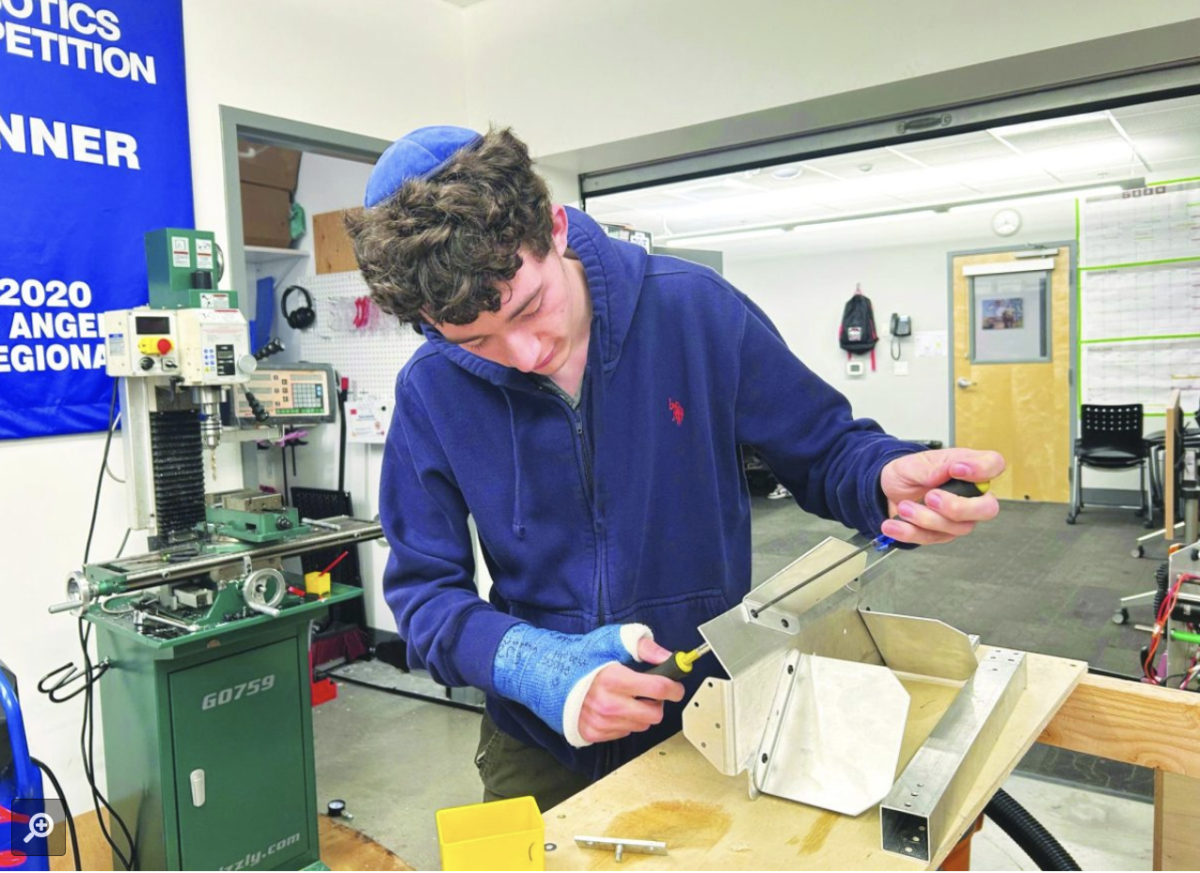
At various times over the last 10 years, the noise of various motors and tools has echoed through the halls of Shalhevet High School. These sounds come from the robotics lab on the second floor, where its members are hard at work creating a student-designed robot designed to complete specific challenges for a competition that they hope will lead their team, Team 6000, to victory at one or two annual competitions in Southern California.
After winning first place in 2020, Team 6000 continues to hold itself to high standards as it pursues ongoing success in regional competitions.
FIRST (For Inspiration and Recognition of Science and Technology) is an international non-profit organization that runs robotics programs for students of all ages, including the FIRST Robotics Competition (FRC), in which high school students design, build, and program a robot each year to compete in a new challenge-based game.
Team 6000 — named because it was the 6000th team in the league to register — is the largest extra-curricular team at Shalhevet High School, with 29 members, approximately one third of whom are female, Robotics Captain Benjy Kolieb said.
“There’s a place for everyone — building, programming, CAD [computer-aided design], electronics, business, outreach,” Benjy said. “We encourage our members to get involved by joining conversations, contributing ideas, not just sitting back.”
The team requires a major commitment of time and energy from all of its members.
“There’s really no off-season,” said Benjy. “We’re in the lab during the school year, summer, days off — always.”
The season begins in early January, when the video released by FIRST releases the annual instruction video. Every season the game changes, but it always involves designing and building a robot to complete specific tasks in response to the prompt released by FIRST Robotics. For example, the 2025 competition was ocean-themed, with robots earning points by collecting and placing certain game-themed pieces called “Coral” and “Algae.”
Students spend “build-season,” which runs from January through March each year, developing a single competition robot through a planned process that includes planning, design, strategy, building and testing. Members work in designated sub-teams, focusing on different aspects of the build process, such as programming and mechanical assembly, using the competition guidelines to determine the robot’s functions.
Team members work collaboratively to finalize their robot’s design and prepare it for competition. In late March, the team travels to venues in Southern California where it is held, and when the competition concludes, so does the season.
“It’s a big time commitment, but it’s rewarding to see something you worked on actually compete,” said Rebecca Davidson ‘27, a member of the team.
Robotics Faculty Advisor Taek Chang said that the effort made by Team 6000 helps create a special sense of collective responsibility among the members.
“One of the greatest highs of being a part of this team has been seeing the members of the team just put in the effort and unite,” Mr. Chang said, “by committing themselves towards a common goal, to try to get an operational robot for our annual competition and come back victorious.”
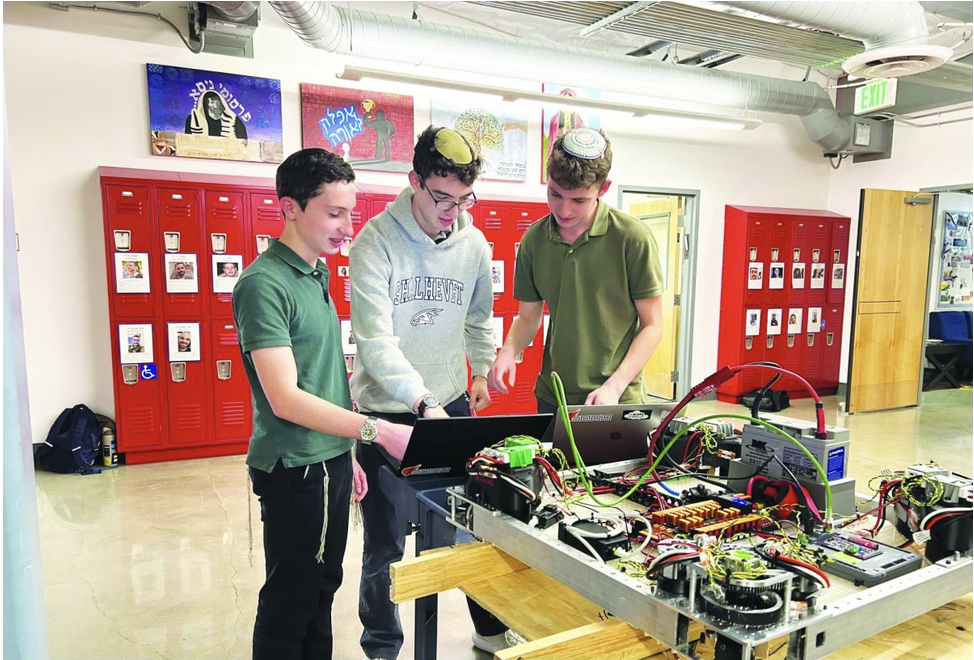
Being an Orthodox Jewish team also presents challenges, including limited availability during Jewish holidays, shorter work windows, and the inability to work on Shabbat. The team, however, has still found a way to operate productively at a high level.
“The main day of the competition is always during Shabbat, and so, being that everybody on the team observes Shabbat, we don’t have an opportunity to actually compete during the main day,” said Mr. Chang, “So then we found a proxy team to drive our robot, and compete on our behalf.”
As long as Team 6000 has been competing, Culver City High’s team, the Bagel Bytes, has driven Shalhevet’s robot, Mr. Chang said.
Over the ten years of the team’s existence, there have been a variety of highs and lows. During the Covid-19 pandemic, all schools in LA county were forced to temporarily close down, causing a major setback for the robotics team.
Overcoming challenges is a major part of Team 6000, which shapes a culture that extends beyond any single season or setback.
At the end of the 2026 build season, the Team 6000 leadership will conduct one-on-one interviews with each member of the team, providing them with the opportunity to reflect on the season and express feedback in an effort to help strengthen the team in future years.
“Every season is a new challenge, and every challenge is a chance to grow stronger as a team,” Mr. Chang said.
This story was published in The Boiling Point of Shalhevet High School on March 6, 2026.