As the clock struck 2:00 am, Yedidya Milner-Gillers (‘25) awoke and quickly followed his fellow classmates to a bomb shelter at Yeshivat Orayata in Jerusalem. Despite the sirens ending and the coast being declared clear, Milner-Gillers remained in the shelter, sleeping on a mattress until normal classes resumed.
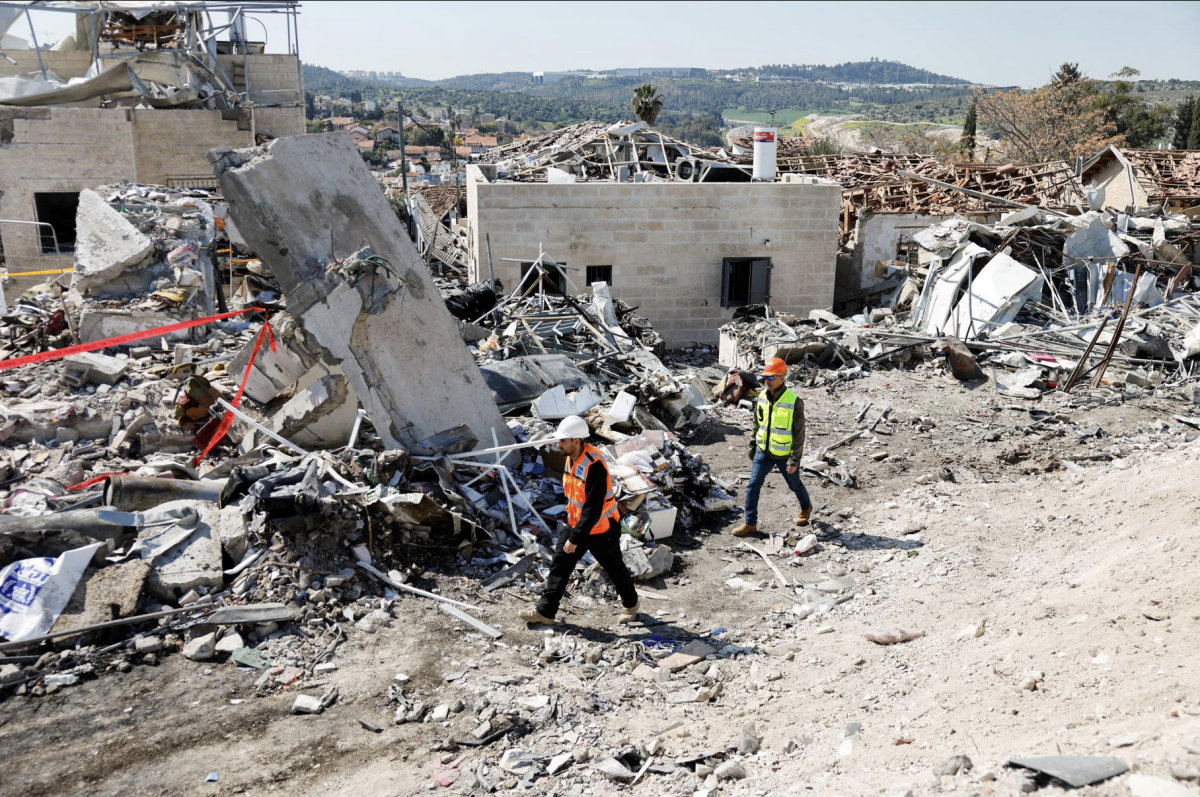
As a gap year student studying abroad, Milner-Gillers’ situation displays the immediate impacts for those in Israel currently facing relentless missile attacks from the Iranian Regime.
In the early morning of Feb. 28, the Israeli Defense Forces (IDF) and the United States military launched a joint operation into Iran that has resulted in a continued 13 days of fighting. Iran’s offense has impacted civilians as attacks have been intermittent in residential areas in Israel.
Milner-Gillers has been studying in Israel since late summer 2025, and he empathizes with native Israelis whose lives are temporarily affected by the current conflict.
“[Israelis] have to wake up every day scared that a missile is going to come and destroy their house and kill them and their family,” Milner-Gillers said. “For us [Yeshiva students], we’re here for a year, but for them, this is the reality.”
According to Milner-Gillers, parents of his Yeshiva classmates are also dealing with limited travel, which is inhibiting their spring break plans. But more importantly, students are unable to travel home because the airspace has been closed in response to the danger posed by the war.
As President of the Israel club, sophomore and Israeli Adi Ben Nun is helping spread awareness and comfort about the current situation through slideshows and group support. She is also in constant contact with her family in Israel, worrying about their safety.
“My whole family is in Israel, it obviously impacts them,” Ben Nun said. “We are constantly texting as they are in bomb shelters and watching the news all the time.”
Another direct impact of the Middle East conflict has been the postponement of the Irene and Daniel Simpkins Senior Capstone Trip to Israel for the graduating senior class of 2026. Due to Israel’s airspace restrictions, seniors have been unable to travel there, and the trip is being rescheduled. In an email to the parents, Head of School Mitchel Malkus said there is a “possibility of a condensed capstone program beginning shortly after Passover, in mid-April, running approximately through mid-June.”
As of March 10, Iran has sent at least 300 missiles to Israel. The current war has since expanded beyond just the original three countries. So far, 12 countries and multiple U.S. allies across the Middle East have been attacked, expanding the conflict into a regional war.
Daniel Silverberg, Managing Director of Corporate Practice at Capstone, thinks that the Iranian regime had a specific motive when responding to Israel’s attack in the way that they did.
“I don’t think anyone was expecting Iran to target Saudi Arabia, the UAE [and] Bahrain in the manner that they did,” Silverberg said. “And it turns out, clearly after the 12-day war over the summer, the regime came up with a strategy that if it is truly threatened, then it’s going to try and drag its neighbors into this fight to raise the cost, and make it more difficult for the US to prosecute the war.”
According to Silverberg, one may or may not see diplomatic failure within the current conflict. He says that Democrats would likely classify President Trump’s backing out of the JCPOA in 2018 as the diplomatic failure itself, which they argue constrained the Iranian nuclear program. Contrastingly, Silverberg argues that Republicans would consider JCPOA itself as the diplomatic issue within the conflict because it constrained the U.S.’s ability to attack Iran.
Silverberg also thinks that President Donald Trump’s approach to this war is significant in its offensive strategy, as his threat was directly aimed at the Iranian regime.
“The mere fact that President Trump entered this as sharply as he did, going after the regime, not a gradual military operational buildup, but going big from the beginning,” Silverberg said. “That’s significant, and it signaled to the Iranians that this is the real moment of existential threat for them.”
In the context of American politics, Silverberg argues that President Trump has taken action in a way that no other president has.
“A lot of Jewish Americans distrust President Trump, [and] strongly abhor his domestic policies,” Silverberg said. “And yet, twice now, he has put muscle behind what–for the last 20 years–most presidents have only used rhetoric of: Stopping Iran. It creates a fundamental ambivalence of whether this [war] is the right thing.”
As a student who studies Torah and finds meaning through it, Milner-Gillers thinks that the classic Jewish principle of remaining in Israel during wartime is valuable during this time of war.
“The most important thing for a person to be doing, if they’re in Israel, if there’s a war going on, is to stay in Israel to learn Torah,” Milner Gillers said. “I think it’s a big sentiment among people. They want to stay here, they want to keep learning just because that’s what ‘s gonna protect us.”
This story was published March 17 in The Lion’s Tale of Charles E. Smith Jewish Day School.